Showing posts with label birds. Show all posts
Showing posts with label birds. Show all posts
Tuesday, July 26, 2011
A challenge to birders - Ross's Turaco in Botswana
 Photo: Courteousy www.flickr.com/
Ross's Turaco is a strikingly beautiful bird found primarily in riverine and other forests in south-central Africa, with the southernmost tip of its range just touching the northern extremity of Botswana. When naturalist/film-maker Tim Liversedge saw the first one in Botswana near Ikoga on the Okavango Panhandle in 1974, he knew that no-one would believe him, so he 'collected' the bird - it is now a museum specimen so there can be no doubt about the authenticity of this record!
Since 1974, informed birders have been keeping an eye out for this brilliant blue turaco along the Okavango Panhandle and the riverine forests along the Linyanti River, as it is likely to occur sporadically in these areas. There have been some claimed sightings, but none has been accepted by BirdLife Botswana's Records sub-committee, which adjudicates these reports. Recently, one of the top guides in northern Botswana, Victor Horatius, sent in an excited and exciting e-mail saying that he'd seen one in the Linyanti Concession near King's Pool Camp, but unfortunately he could not get a photograph of it . . .
Thus Ross's Turaco remains elusive in Botswana. This bird is undoubtedly seen more than once in 40 years, and in this day and age of high resolution digital cameras, it will only take one clear photo to confirm that the species is alive and well in northern Botswana. This is our challenge to birders - keep your cameras at the ready when visiting the northern part of the country!


Friday, February 26, 2010
BirdLife Botswana AGM 2010
Please make a note of 15th May as that will be the date for our AGM, which will be held at Harold and Geraldine Hester's residence, Mogorosi, Plot 30a Notwane. The meeting will start at 18:00 and will be followed by a light supper. Closer to that date we will circulate the agenda and other details.
Sunday, December 20, 2009
Common Bird Monitoring gains momentum
 The European Roller is one of the migratory species being monitored (Photo: P Hancock)
BirdLife Botswana’s Common Bird Monitoring (CBM) project aims to establish trends in the numbers of birds in Botswana, even those which are not globally or nationally threatened, to provide an indication of the status of biodiversity in the country. It is anticipated that the information gathered will be useful for the Convention on Biological Diversity as well as within the country where it will inform conservation priorities in terms of species and issues.
The monitoring is conducted during February and November every year, and the November session has just been completed. Transects were conducted mainly throughout the Chobe, Ngamiland and Ghanzi Districts with lower coverage of other areas, and our sincere thanks go to all who participated. The good returns from the northern part of the country are largely due to the CBM co-ordinators within the Department of Wildlife and National Parks: Mothusi Jenamiso, assisted by BirdLife Botswana member Pete Laver, in Kasane; Zee Mpofu in Maun; and Lucas Matthys and Gloria Ndobano in Ghanzi.
The project only really started in February of this year, and since then the number of participants has increased markedly. However, it is too early for any trends to be determined; these will only become apparent after several years. Consequently we urge participants to prepare themselves for the February 2010 monitoring period. New participants are always welcome, to increase the national coverage. The counts are fun, and only take a morning twice a year. If you are interested in contributing, contact one of the co-ordinators mentioned above, or Justin Soopu at the BirdLife Botswana office in Gaborone (3190541) or Pete Hancock at the BirdLife Botswana office in Maun (6865618/74654464). We especially need more transects done in Central and Kgalagadi Districts.
Special thanks to the following for assistance with the November counts: Danae Sheehan (RSPB), Rumbidzai Kaparadza, Mothusi Jenamiso, Baldwin Mashaba, Thatayaone Rabakane, Kabo Kgopa, Cruise Mollowakgatla, Cedric Somotanzi, Martin Kays, Johnny Mowanji, Kambango Sinimbo, Kevin Grant, Lorraine Boast, Birthe Gjern, TJ Lesifi, Eugenie and Mark Skelton, Zee Mpofu, Gloria Ndobano, Pete Laver, Mike Soroczynski, Nicky Bousfield, Harold Hester, and Oreemetse Dingake.

 (Photos: D Sheehan)
Tuesday, December 8, 2009
Capacity-building for communities: Mosu workshop
BirdLife Botswana and the Dept. of Wildlife and National Parks are conducting a series of capacity-building workshops for the communities of Mmeya, Mosu and Mmatshumo in the southern part of Sua Pan, to empower them to conserve the natural resources of the area (in particular, the second largest breeding site of the Lesser Flamingo in Africa) and to improve their livelihoods through tourism in the Makgadikgadi. The first workshop was held in Mmatshumo Village during October this year, and explored ways of bringing the three villages together to achieve a common vision for their area. This was followed last week by a second workshop in Mosu Village, where community members developed a Strategic Plan to guide their activities. The third workshop will be held in Mmeya Village early in the new year. The first workshop was held at the Gaing-O Trust offices in Mmatshumo
 Back to school in Mosu! The second workshop was held at Mosu primary school
The community workshops are part of the UNDP-GEF funded project “Strategic Partnerships to Improve the Operational and Financial Sustainability of Protected Areas”. The project aims to promote stakeholder engagement in biodiversity conservation in the Makgadikgadi area, and is a sister project to the Makgadikgadi Integrated Management Plan currently underway.
 The first workshop was held at the Gaing-O Trust offices in Mmatshumo
 Back to school in Mosu! The second workshop was held at Mosu primary school
The community workshops are part of the UNDP-GEF funded project “Strategic Partnerships to Improve the Operational and Financial Sustainability of Protected Areas”. The project aims to promote stakeholder engagement in biodiversity conservation in the Makgadikgadi area, and is a sister project to the Makgadikgadi Integrated Management Plan currently underway.
Wednesday, November 11, 2009
Okavango fish traps


by Grant Atkinson and Helena Faasen (Okavango Wilderness Safaris)
The recent high water levels in the Okavango Delta are now a thing of the past. One result of this year’s big flood is the exciting bird viewing that is taking place as thousands of fish become trapped by the receding waters.
These fish become a magnet for many species of waterbirds, and on a recent visit to Chitabe Camp we got to experience some of the action associated with these so-called ‘fish traps.” Instead of viewing birds just flying overhead, or standing somewhere, the fish traps bring many species together and the interaction that occurs between them is fascinating. Forced into close proximity with one another, the birds compete, co-operate, fight and steal from one another. The particular pool that we spent most time at near Chitabe was dominated for a while by a pair of Saddle-billed Storks. The pair were happy to share the pool with several smaller species of birds, but objected to a flock of Yellow-billed Storks, and some Pink-backed Pelicans, that joined in the action. For almost an hour the two Saddle-billed Storks chased all the other storks and pelicans away, but eventually they either grew tired of the effort, or else they had caught enough fish for themselves.
Birding action like we observed will be happening all over the Okavango over the next few months, and it will last until the annual floodwaters arrive and once again bring the sanctuary of deep water to the fish.
Friday, September 25, 2009
Community workshop at Nata Sanctuary
Nata Sanctuary was a hive of activity during the latter part of August as 35 community members from Trusts throughout the country gathered for a week’s training in bird identification and monitoring. The workshop was organized and conducted by staff from the Department of Wildlife and National Parks (DWNP) and BirdLife Botswana, and was the first of its kind involving community members in Common Bird Monitoring and Important Bird Area (IBA) Monitoring. An introduction to the Management Oriented Monitoring System (MOMS), promoted by DWNP for use in community concession areas, also formed part of the training. Some participants were from new Trusts and were able to interact with, and benefit from, other long-standing Trusts from the northern part of the country which had full-time Community Escort Guides involved in natural resources monitoring. Basic skills in bird identification are needed before anyone can participate meaningfully in bird monitoring, so logically this formed the starting point for the course. The focus for this part was on common birds (needed for Common Bird Monitoring) and ‘trigger species’ for each IBA (needed for IBA monitoring). This led on to sessions on Common Bird Monitoring, presented by Pete Hancock, and IBA monitoring, facilitated by Virat Kootsositse – these included both theory and field practicals so that participants would feel comfortable about initiating these activities back in their areas. The MOMS session, conducted by Malebogo Sentsho, linked very closely with the IBA monitoring, and some of the community members who have already been implementing MOMS contributed meaningfully to the discussions on integrating MOMS and IBA monitoring.
The final day of the workshop was devoted to sharing experiences and lessons learnt in managing Trusts and their activities, for the benefit of the newer Trusts that BirdLife Botswana is engaging with. Boitumelo Sekhute-Batungamile introduced BirdLife Botswana’s PSPA project - centred on promoting community involvement in birding tourism in the Makgadikgadi area – and this provided the necessary background to show where the new community organizations fitted in. Resource persons from Government, primarily DWNP, assisted to facilitate and guide discussions to ensure that the framework provided by the CBNRM Policy was clear, so that all Trusts operate within the parameters set by the Policy.
The highlight of the workshop was the evident willingness of community members to engage in bird monitoring in their areas. Without exception, communities were enthusiastic to become active partners with DWNP and BirdLife Botswana in collecting data which could contribute to the management of their areas, and help meet the Botswana Government’s obligation to the Convention on Biological Diversity.
The workshop was made possible firstly by the Nata Sanctuary Trust, which provided the venue, but also by funding from three donor agencies which are supporting BirdLife Botswana projects viz. Royal Society for the Protection of Birds (Common Bird Monitoring), European Union (IBA/PA monitoring) and GEF-UNDP (the PSPA project) – they are all thanked for their contribution towards making the workshop a success.
 Basic skills in bird identification are needed before anyone can participate meaningfully in bird monitoring, so logically this formed the starting point for the course. The focus for this part was on common birds (needed for Common Bird Monitoring) and ‘trigger species’ for each IBA (needed for IBA monitoring). This led on to sessions on Common Bird Monitoring, presented by Pete Hancock, and IBA monitoring, facilitated by Virat Kootsositse – these included both theory and field practicals so that participants would feel comfortable about initiating these activities back in their areas. The MOMS session, conducted by Malebogo Sentsho, linked very closely with the IBA monitoring, and some of the community members who have already been implementing MOMS contributed meaningfully to the discussions on integrating MOMS and IBA monitoring.
The final day of the workshop was devoted to sharing experiences and lessons learnt in managing Trusts and their activities, for the benefit of the newer Trusts that BirdLife Botswana is engaging with. Boitumelo Sekhute-Batungamile introduced BirdLife Botswana’s PSPA project - centred on promoting community involvement in birding tourism in the Makgadikgadi area – and this provided the necessary background to show where the new community organizations fitted in. Resource persons from Government, primarily DWNP, assisted to facilitate and guide discussions to ensure that the framework provided by the CBNRM Policy was clear, so that all Trusts operate within the parameters set by the Policy.
The highlight of the workshop was the evident willingness of community members to engage in bird monitoring in their areas. Without exception, communities were enthusiastic to become active partners with DWNP and BirdLife Botswana in collecting data which could contribute to the management of their areas, and help meet the Botswana Government’s obligation to the Convention on Biological Diversity.
The workshop was made possible firstly by the Nata Sanctuary Trust, which provided the venue, but also by funding from three donor agencies which are supporting BirdLife Botswana projects viz. Royal Society for the Protection of Birds (Common Bird Monitoring), European Union (IBA/PA monitoring) and GEF-UNDP (the PSPA project) – they are all thanked for their contribution towards making the workshop a success.
Tuesday, September 22, 2009
Will Lake Xau fill?
The flow of the Okavango’s waters down the Boteti River this year have been nothing short of spectacular, with the front of the flood approaching Rakops (over 200km from Maun) at present.
While predicting the future is fraught with all sorts of risks, it seems likely that it is a question of when, not if, the water will once again reach Lake Xau, which is the terminus for the Boteti. This assumes of course that Debswana will remove the structures they built previously to channel water into the Mopipi Dam, but given their recent track record (where they removed the bund blocking the Nhabe Channel leading to Lake Ngami), this looks likely. During wetter decades, Lake Xau was a substantial waterbody, and supported spectacular birdlife; the front cover of Smither’s 1964 Checklist of Birds of the Bechuanaland Protectorate depicts a Gull-billed Tern flighting over Lake Xau, and this is the type of rarity that may well turn up at the Lake again when it floods.
Since the Lake has been dry for several decades now, the lakebed has grassed over, and it is currently not unlike Lake Ngami was before the recent floods. Lake Xau is also similar to Lake Ngami in being a nutrient sink with rich soils that, when flooded, will result in nutrient-rich, eutrophic waters in an otherwise dry area. Lake Xau will almost certainly attract and support a diverse suite of waterbirds – in large numbers – when it finally floods. However, it will not be a destination for ‘armchair’ birders – the location is quite remote, there are no facilities in the area, and access will be difficult. For serious birdwatchers, though, it will be worth watching this Blog for updates on the status of the area.
 View of the dry bed of Lake Xau (in distance) from Kedia Hill
While predicting the future is fraught with all sorts of risks, it seems likely that it is a question of when, not if, the water will once again reach Lake Xau, which is the terminus for the Boteti. This assumes of course that Debswana will remove the structures they built previously to channel water into the Mopipi Dam, but given their recent track record (where they removed the bund blocking the Nhabe Channel leading to Lake Ngami), this looks likely. During wetter decades, Lake Xau was a substantial waterbody, and supported spectacular birdlife; the front cover of Smither’s 1964 Checklist of Birds of the Bechuanaland Protectorate depicts a Gull-billed Tern flighting over Lake Xau, and this is the type of rarity that may well turn up at the Lake again when it floods.
Since the Lake has been dry for several decades now, the lakebed has grassed over, and it is currently not unlike Lake Ngami was before the recent floods. Lake Xau is also similar to Lake Ngami in being a nutrient sink with rich soils that, when flooded, will result in nutrient-rich, eutrophic waters in an otherwise dry area. Lake Xau will almost certainly attract and support a diverse suite of waterbirds – in large numbers – when it finally floods. However, it will not be a destination for ‘armchair’ birders – the location is quite remote, there are no facilities in the area, and access will be difficult. For serious birdwatchers, though, it will be worth watching this Blog for updates on the status of the area.
 View of the dry bed of Lake Xau (in distance) from Kedia Hill
Monday, August 31, 2009
Coming soon - Avitourism handbook
.jpg) BirdLife Botswana staff members, Keddy Mooketsa and Boitumelo Sekhute-Batungamile, are to be congratulated on the development of an avi-tourism handbook – a practical guide to starting a community-based birding tourism business. This handbook provides useful information on how to go about using birds in a sustainable, non-consumptive way (through tourism) to improve rural livelihoods, and thereby create a real value for birds that will ultimately lead to their conservation.
BirdLife Botswana staff members, Keddy Mooketsa and Boitumelo Sekhute-Batungamile, are to be congratulated on the development of an avi-tourism handbook – a practical guide to starting a community-based birding tourism business. This handbook provides useful information on how to go about using birds in a sustainable, non-consumptive way (through tourism) to improve rural livelihoods, and thereby create a real value for birds that will ultimately lead to their conservation.Often people living adjacent to Important Bird Areas (IBAs) do not realize the value of birds, but with birding tourism growing worldwide, avi-tourism is a viable way of generating income from birds, with adequate marketing. Once people see the benefit of birds, it is easy to involve them in the protection and monitoring of the resource. This approach has been successfully used by BirdLife partners in South Africa and Kenya, for example, to create meaningful employment, and to show the value of birds, and BirdLife Botswana is now following their example.
The avi-tourism handbook, which is due out soon, will complement the specialist bird guide training that has already been initiated by BirdLife Botswana staff.
Thursday, July 16, 2009
Too much of a good thing?
With the Okavango River at its highest flood level for decades at present, there have been great expectations for good birding as water reaches areas that have been dry for a long time. Throughout the Delta, water levels are high, and this has had the somewhat unexpected effect of forcing wading birds into peripheral areas. The result is that the central parts of the Delta are noticeably devoid of birds.
July is the month for the African Waterbird Counts, and long-standing transects that have been counted in the Okavango so far are turning up very few birds. The heronries at Xakanaxa, Gadikwe and Gcobega have been surprisingly quiet, and the same applies to other areas. Water at Lake Ngami is deeper and more extensive than at any other time in the recent past, and waterbirds are conspicuous by their absence.
However, along the fringes of inundated floodplains such as the Khwai and Gomoti, birding is much better. Unusually, sizeable flocks of Wattled Cranes are being seen along the Khwai River, an area previously considered marginal for this flodplain specialist. These are likely to be birds forced out of their normal areas by high water, or they may simply be taking advantage of the improved conditions at Khwai. The Gomoti floodplain is teeming with Slaty Egrets, Glossy and African Sacred ibis and a variety of ducks and geese.
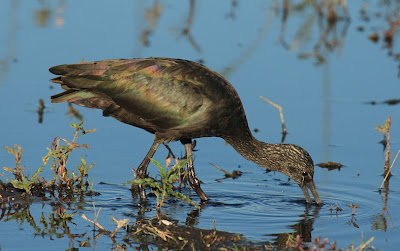 Glossy Ibis probing the shallow floodplain margins (Photo: P Hancock)
Please keep the BirdLife Office in Maun informed of any build-up of waterbird numbers anywhere in the Okavango Delta system.
July is the month for the African Waterbird Counts, and long-standing transects that have been counted in the Okavango so far are turning up very few birds. The heronries at Xakanaxa, Gadikwe and Gcobega have been surprisingly quiet, and the same applies to other areas. Water at Lake Ngami is deeper and more extensive than at any other time in the recent past, and waterbirds are conspicuous by their absence.
However, along the fringes of inundated floodplains such as the Khwai and Gomoti, birding is much better. Unusually, sizeable flocks of Wattled Cranes are being seen along the Khwai River, an area previously considered marginal for this flodplain specialist. These are likely to be birds forced out of their normal areas by high water, or they may simply be taking advantage of the improved conditions at Khwai. The Gomoti floodplain is teeming with Slaty Egrets, Glossy and African Sacred ibis and a variety of ducks and geese.
 Glossy Ibis probing the shallow floodplain margins (Photo: P Hancock)
Please keep the BirdLife Office in Maun informed of any build-up of waterbird numbers anywhere in the Okavango Delta system.
Monday, July 13, 2009
Interesting sightings from Tachila
Tachila Nature Reserve, near Francistown, is a new privately run wildlife sanctuary that aims to provide opportunities for environmental education for schoolchildren from throughout the country. It is also a worthwhile birding destination, and BirdLife Botswana Board member, Nicky Bousfield (who has been the driving force behind the establishment of the reserve)sent in the following highlights recently:
"The following are some of the interesting sightings from Tachila:
Short-toed Rock-Thrush (eastern race, with uniform slate-blue crown) Monticola brevipes pretoriae
Freckled Nightjar Caprimulgus tristigma (this bird is marginal in eastern Botswana)
Black Stork Ciconia nigra (uncommon in Botswana)
Boulder Chat Pinarornis plumosus (marginal in Botswana)
Bronze-winged Courser Rhinoptilus chalcopterus
Three-banded Courser Rhinoptilus cinctus (marginal in Botswana)
Yellow-billed Egret Egretta intermedia (uncommon in eastern Botswana)
 Yellow-billed Egret (Photo: P Hancock)
African-Fish-Eagles are breeding at Tachila for the third year in a row. Other raptors seen from time to time include Bateleur, African Hawk-Eagle, Black-chested Snake-Eagle, White-backed and Lappet-faced vultures".
"The following are some of the interesting sightings from Tachila:
Short-toed Rock-Thrush (eastern race, with uniform slate-blue crown) Monticola brevipes pretoriae
Freckled Nightjar Caprimulgus tristigma (this bird is marginal in eastern Botswana)
Black Stork Ciconia nigra (uncommon in Botswana)
Boulder Chat Pinarornis plumosus (marginal in Botswana)
Bronze-winged Courser Rhinoptilus chalcopterus
Three-banded Courser Rhinoptilus cinctus (marginal in Botswana)
Yellow-billed Egret Egretta intermedia (uncommon in eastern Botswana)
 Yellow-billed Egret (Photo: P Hancock)
African-Fish-Eagles are breeding at Tachila for the third year in a row. Other raptors seen from time to time include Bateleur, African Hawk-Eagle, Black-chested Snake-Eagle, White-backed and Lappet-faced vultures".
Ringed Pratincoles at Lake Ngami
 One of the ringed pratincoles (Photo: K Oake)
An observant Maun birder, Ken Oake, recently spotted two Collared Pratincoles with rings (bands) at Lake Ngami, and managed to get a clear photo of one of them. Unfortunately the number on the ring is not legible, making this a somewhat tantalising observation as we cannot be certain of the origin of the bird. It is most likely that it was among the 61 Collared Pratincoles ringed at the Lake during an AFRING training course in December, 2005, and if this is the case, it would mean that the pratincoles are returning to this important site. Only 283 Collared Pratincoles have ever been ringed, so it is great to get a resighting of one of them, even if the information is incomplete.
Birders at Lake Ngami should also keep a look out for other bird species with rings - for example, a large number of Kittlitz's Plovers were ringed there during the AFRING course, and none of them have been re-sighted or recovered to date.
Friday, July 3, 2009
New (overlooked) record for Botswana bird list?
During the Peterhouse School scientific expeditions to Botswana between 1966 and 1970, schoolchildren under the supervision of Peter Ginn (well-known as the editor of ‘A Complete Book of Southern African Birds’) collected bird specimens from the Makgadikgadi area. During one of these outings, a gull that was collected in the Nata area, in the company of Grey-headed Gulls, turned out to be an exciting find. Once the group had returned to Zimbabwe, the gull was tentatively identified by Mr Stuart Irwin from the Natural History Museum as Larus novaehollandiae. This was subsequently confirmed by Messrs CW Benson and PR Colston at the British Museum of Natural History.
When Larus novaehollandiae was later split, the nominate race in Australia retained the name L. novaehollandiae and the southern African birds became L. hartlaubii. This species is restricted as a breeding bird to the coldwater coasts of Namibia and the Western Cape, and sightings inland are quite unusual.
However the interesting thing about this observation is that Larus hartlaubii does not feature on the Botswana bird list. There is no mention of it in the Bird Atlas of Botswana – this ‘bible’ for birds in Botswana included historical data on our birds as well as observations spanning the decade 1980 to 1990. Could this species have been overlooked?
It would be interesting to know the whereabouts of the specimen collected by the Peterhouse expedition, to confirm its identity. Anyone who knows anything about this observation is invited to comment below.
When Larus novaehollandiae was later split, the nominate race in Australia retained the name L. novaehollandiae and the southern African birds became L. hartlaubii. This species is restricted as a breeding bird to the coldwater coasts of Namibia and the Western Cape, and sightings inland are quite unusual.
However the interesting thing about this observation is that Larus hartlaubii does not feature on the Botswana bird list. There is no mention of it in the Bird Atlas of Botswana – this ‘bible’ for birds in Botswana included historical data on our birds as well as observations spanning the decade 1980 to 1990. Could this species have been overlooked?
It would be interesting to know the whereabouts of the specimen collected by the Peterhouse expedition, to confirm its identity. Anyone who knows anything about this observation is invited to comment below.
Subscribe to:
Posts (Atom)

